

 English
 русский
 عربى
News
Home / News / Industry News / Batch Dryer vs Continuous Grain Dryer: Which Fits Your Harvest Flow Best?

Content
Two grain operations finish harvest in the same week. The first runs a 15-tonne batch dryer: fill at 22:00, moisture check at 02:00, a 20-minute cooling cycle, dump at 04:00, then start again. The second pushes 40 tonnes an hour through a continuous column dryer that never stops between the first truck and the last. Both ship grain at around 14% moisture. Neither machine is universally better, because they solve different problems: one manages small lots with tight control, the other manages a flow that cannot be paused.
The short version: a batch dryer buys you control, crop flexibility and a lower entry price. A continuous grain dryer buys you throughput, fewer labor hours per tonne and steadier output at volume. Below roughly 250 to 400 tonnes of peak daily intake, or when you dry several crops in small lots, batch usually wins. Above that, and when stopping the combines is not an option, continuous flow is the practical route.
A batch dryer holds a fixed quantity, commonly 5 to 30 tonnes in farm-scale units and larger in commercial installations. Grain is loaded, dried as a static or slowly stirred mass, cooled in the same chamber and discharged before the next load begins. Because each load is a defined event, the operator can sample moisture at the end of the cycle and add time if the grain is still tough. You cannot accidentally discharge grain that is not ready, which is both the core strength and the reason it works in steps rather than in a stream.
A continuous dryer moves grain down through heated sections and discharges it at target moisture while wet grain keeps entering the top. The machine is only as good as the flow through it. Feed it unevenly, or shut it down overnight and restart in the morning, and drying quality drops: grain that lingers in the hot zone leaves over-dried and brittle, while grain that passes too quickly leaves tough. That is why a wet bin ahead of the dryer is effectively mandatory, buffering the gap between how fast the combine delivers and how fast the dryer can absorb.
Both designs work on heated air. Grain heats up, its internal vapour pressure rises above that of the surrounding air, and moisture moves outward. Higher air temperature and higher airflow raise the drying rate. The process passes through a heating phase, a constant-rate phase where surface moisture evaporates quickly and evaporative cooling keeps kernel temperature in check, and falling-rate phases where water must migrate from the centre of the kernel to the surface. That last stage is slow, and it is where aggressive settings cause damage instead of speed.
The factors below usually settle the decision before price is even discussed.
| Comparison point | Batch dryer | Continuous flow dryer |
|---|---|---|
| Load or throughput | 5 to 30 t per cycle, larger in commercial units | 10 to 60+ t per hour, running continuously |
| Wet bin requirement | Optional; the dryer itself buffers supply | Effectively required, sized to 6 to 12 hours of intake |
| Labor | Frequent checks tied to each cycle | Low hours per tonne once feed and discharge are set |
| Moisture consistency | Verified load by load | Excellent at steady flow, drifts with stop-start running |
| Start-stop behaviour | Normal operation | Uneven drying and quality loss |
| Crop flexibility | High; small lots and specialty crops are practical | Best in long runs of one or two main crops |
| Fuel per tonne | Higher at low volume | Lower at high volume |
| Typical fit | Small to mid-size farms, seed, multi-crop sites | Large farms, elevators, feed and processing plants |
ControlCrop flexibilityLower entry cost
ThroughputLow labor per tonneConsistency at scale
Once the flow is set, the machine runs with minimal intervention. Grain goes in wet and comes out at a repeatable moisture level, which is the single most valuable property when the next step is a feed mill, a milling process or a contract with a strict specification.
Budget honestly for the trade-off: the wet bin, extra conveying and automation belong to the same purchase. A continuous dryer running well below design flow performs worse than a batch dryer doing the same job.
Drying too aggressively shows up weeks later. Rapid moisture removal from the kernel surface while the centre is still wet creates stress cracks, and cracked grain breaks during conveying, loses milling yield and stores badly. Most operators aim for a final moisture between 13% and 15%, depending on crop, climate and storage duration.
Tempering helps: letting grain rest for a few hours between drying passes allows internal moisture to equalise, so the next pass removes water without over-drying the outer layers. Cooling belongs to the same quality chain, because grain discharged hot and sent straight to a silo sweats as it cools, and that surface moisture is exactly what mould needs.
 SKLN Series Counter-Flow Cooler for PelletsThis counter-flow cooler handles hot, humid pellets and particles, using gradual cooling to protect surfaces and set final temperature after drying.View Product →
The same logic runs through feed production, where pelleted and extruded material passes through a counterflow cooler before storage. In both cases the cooling stage is not an afterthought; it is where the final moisture and temperature of the product are actually set.
Two drying lines with identical dryers can perform very differently because of cleaning, conveying and storage. Fines are the usual suspect: they concentrate moisture, pack down and restrict airflow through the grain mass, so a dryer that is perfectly capable on clean grain turns uneven on dirty grain. Pre-cleaning ahead of the dryer is cheap insurance.
Handling capacity has to match the dryer, not the farm's average day. An undersized elevator or conveyor turns the dryer into a bottleneck and invites exactly the stop-start operation that continuous dryers handle badly.
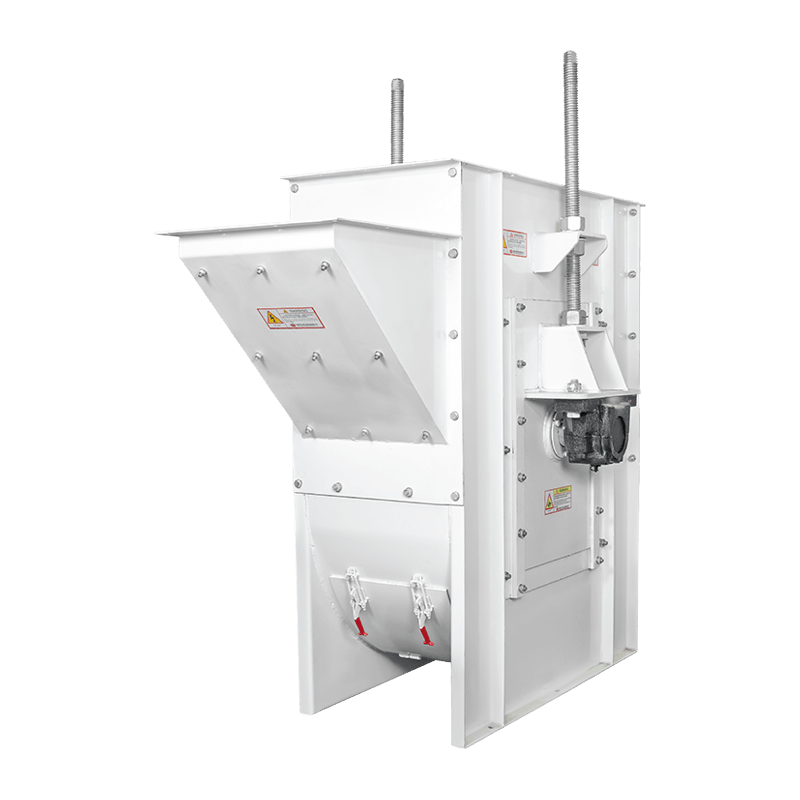 Series Bucket Elevator for Grain HandlingThis bucket elevator conveys powder and granular materials, helping match dryer output and avoid bottlenecks in continuous grain drying and handling lines.View Product →
After drying and cooling, grain still has to reach the right silo without mixing batches at different moisture levels. Rotary distributors and correctly sized drag or screw conveyors do that work, while dust collection keeps the area safe and workable.
 TFPX Rotary Distributor for Silo FeedingThis gravity-fed rotary distributor feeds material from one point to multiple bins, helping route dried grain to the correct silo without mixing batches.View Product →
Goldlong Machinery and Engineering builds this surrounding scope as part of complete grain drying solutions, covering pre-cleaning, drying, conveying, distribution and silo storage, delivered as a turn-key project with installation, commissioning and operator training.
Compare dryers on cost per tonne per point of moisture removed, not on purchase price alone. Physics sets a floor: evaporating one kilogram of water takes roughly 2,500 to 2,800 kJ of heat once grain heating losses are included. Taking 1,000 tonnes of corn from 20% down to 15% means removing close to 59 tonnes of water, so burner efficiency and airflow design translate directly into money.
At small volumes, the labor difference often outweighs the fuel difference. At large volumes, it reverses.
Daily volume matters more than the crop. Under roughly 250 to 400 tonnes of peak intake, a batch dryer usually gives better control for less capital. Above that, a continuous dryer with an adequate wet bin moves corn faster with fewer labor hours per tonne.
In practice, yes. Size it for 6 to 12 hours of harvest intake. Without a buffer, the dryer starves whenever trucks pause, and every stop-start cycle widens the spread between over-dried and under-dried grain.
A batch unit is more forgiving across crops because each load is a separate event. A continuous dryer handles multiple crops if airflow, temperature and discharge rate are adjustable, but short runs of small lots waste its advantage.
Energy per kilogram of water is fixed by physics, so cost per point falls as throughput and dryer efficiency rise. Two dryers of equal capacity can therefore differ noticeably in annual fuel cost, which is why airflow design and heat recovery matter more than a small difference in price.
If you are specifying a drying line, work backwards from four numbers: peak daily intake in tonnes, the crops and their incoming moisture range, the target storage moisture, and whether anyone will be on site overnight. Those answers narrow the choice between batch and continuous long before quotations are compared.
Goldlong Machinery and Engineering designs, manufactures and commissions this equipment as complete projects, including a reference silo and dryer project alongside poultry, aquatic and material handling lines delivered to customers in Russia, Romania, Indonesia, the Philippines, Bangladesh, Pakistan, Saudi Arabia and Sudan. Spare parts, maintenance training and ongoing technical support come with the same package.


 Previous
