

 English
 русский
 عربى
عربىNews
Content
- 1 Why Mixing Uniformity Decides Feed Quality
- 2 Measuring Uniformity with the Coefficient of Variation
- 3 Horizontal vs Vertical Feed Mixers
- 4 Ribbon vs Paddle Configurations
- 5 Strategies for Uniform Micro-Ingredient Distribution
- 6 Preventing Residue Build-Up and Carryover
- 7 Optimizing Cycle Time Without Sacrificing CV
- 8 Selection Checklist for Your Operation
- 9 Frequently Asked Questions
- 9.0.1 Q1: What CV should an animal feed mixer machine achieve?
- 9.0.2 Q2: How long should a batch be mixed?
- 9.0.3 Q3: Is a ribbon or paddle agitator better for high fat formulas?
- 9.0.4 Q4: How can residue build-up be reduced?
- 9.0.5 Q5: How often should mixing uniformity be tested?
- 9.0.6 Q6: Does a larger mixer always give better uniformity?
Every batch of feed is only as good as its weakest scoop. When a few grams of vitamin premix, trace minerals, or a medicated additive land unevenly in a ration, some animals receive too little while others receive too much. Choosing the right animal feed mixer machine is therefore a nutrition decision before it becomes an equipment decision. This guide compares horizontal and vertical designs, explains how uniformity is measured, and shows how ribbon and paddle layouts, ingredient sequencing, and cycle time work together to deliver consistent batches.
Why Mixing Uniformity Decides Feed Quality
Formulation software can balance a ration to the second decimal, yet the animal eats what the mixer delivers, not what the spreadsheet promised. Ingredients with different particle sizes, densities, and electrostatic behavior tend to separate during mixing and again during conveying and bagging. A micro-ingredient dosed at a few hundred grams per tonne has very little room for error, because every scoop of finished feed must still carry its fair share.
5%CV often targeted for premix-sensitive diets
10%Common upper limit for complete feed
2 to 4 minTypical dry mixing window in efficient horizontal designs
Poor mixing shows up in ways that are easy to misdiagnose. Variable growth within a pen, inconsistent eggshell quality, unexplained digestive upsets, or medication that seems to work only on some days can all trace back to uneven distribution rather than to the formula itself. Plant audits regularly find that a mixer which performed well at commissioning has drifted out of tolerance because of worn ribbons, loosened paddles, or habitual overfilling.
A mixer does not add nutrition to a ration. It protects the nutrition that the formula already contains.
Where the cost of poor mixing appears
- Animal performance: uneven intake of trace minerals and vitamins leads to uneven growth and health.
- Regulatory exposure: medicated feed rules expect documented evidence of uniform distribution.
- Wasted premix: operators often over-dose additives to protect against the weakest samples.
- Lost confidence: customers who see variable results rarely blame the mixer first, they blame the feed supplier.
Mixing quality also shapes the economics of a feed operation. A plant that cannot trust its CV must either inflate additive inclusion rates or accept performance risk, and both choices erode margin over a year of production. Documenting uniformity with regular tracer tests turns mixer performance from an assumption into a managed quality metric that can be reviewed, trended, and improved. Treat the mixer as the final control point in the process, because no downstream step can correct a batch that has already left the trough uneven.
Measuring Uniformity with the Coefficient of Variation
The coefficient of variation, or CV, expresses how much a tracer concentration differs from sample to sample relative to the average. A low CV means every sample looks like the mean. A high CV means pockets of the batch are rich or lean. Because it is a ratio, CV allows fair comparison between different tracers, batch sizes, and machines.
How a mixer test is run
- Choose a tracer, such as a fine salt, a microtracer, or an ingredient that can be assayed reliably.
- Run the mixer at a normal fill level with a representative formula.
- Collect at least ten samples from different positions, using a probe or the discharge stream.
- Analyze every sample with the same laboratory method.
- Compare the resulting CV with the target set for that diet.
What the numbers mean
| CV band | Interpretation | Typical action |
|---|---|---|
| Below 5 percent | Excellent | Maintain current routine |
| 5 to 10 percent | Good for most feeds | Monitor each season |
| 10 to 15 percent | Marginal | Extend time, inspect wear |
| Above 15 percent | Poor | Repair, reduce fill, reassess |
Two cautions apply. First, a single passing test is a snapshot, not a guarantee, so tests should be repeated seasonally and after any repair. Second, the tracer must behave like the ingredient it represents. A free-flowing, fine tracer can flatter a mixer that struggles with sticky or oily micro-ingredients.
Sample location matters as much as sample count. Collecting every sample from the discharge stream may hide dead zones, while probing only the top of the trough ignores stratification. A balanced plan combines samples from several depths and from the early, middle, and late portions of discharge. Recording the date, fill level, mixing time, and formula for each test also makes later trends easier to interpret, because a drift in CV can then be linked to a change in operating practice rather than guessed at.
Horizontal vs Vertical Feed Mixers
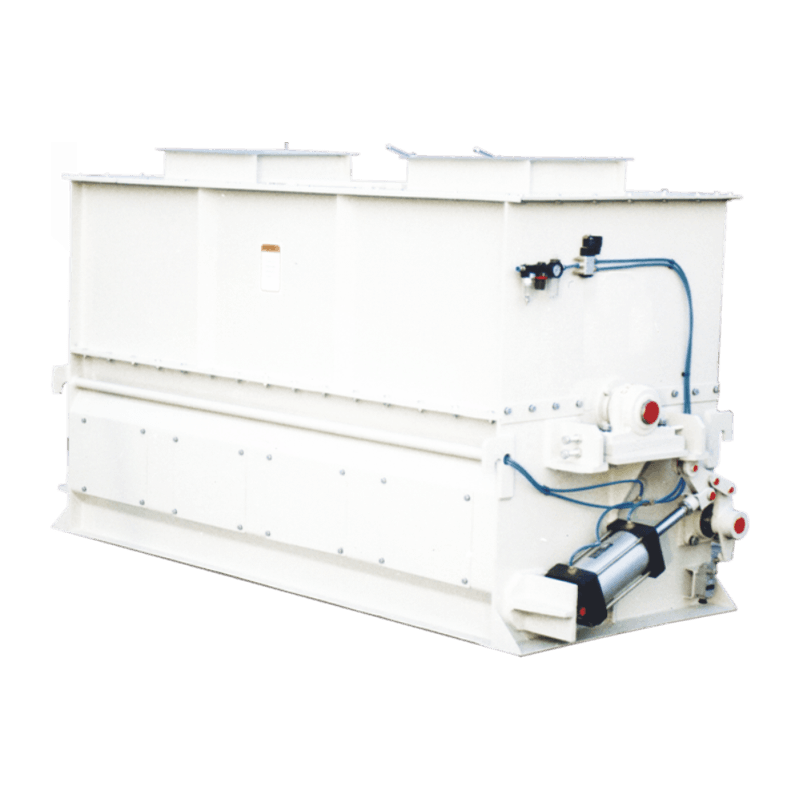
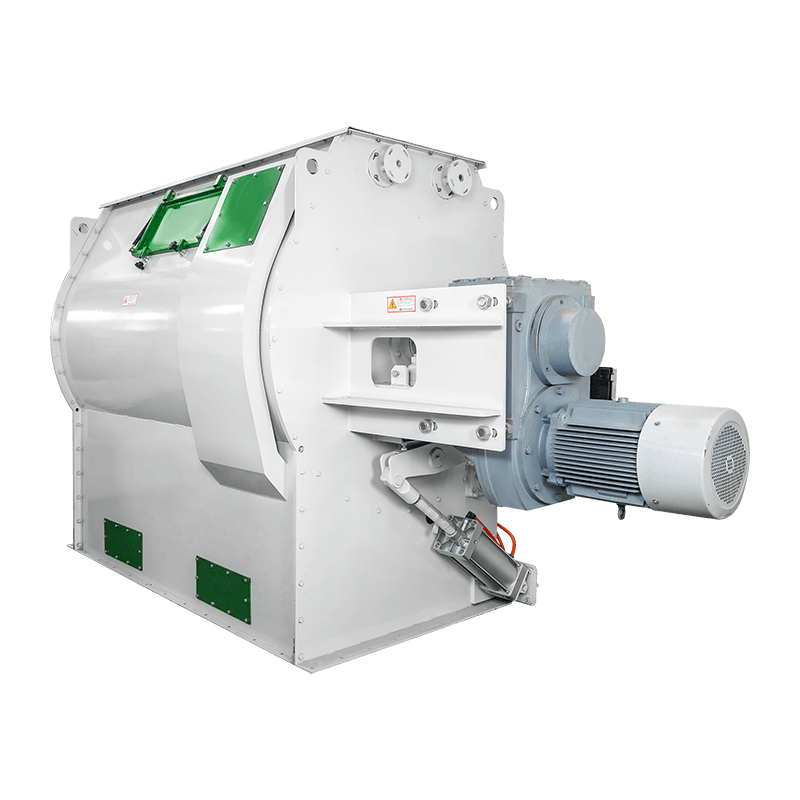
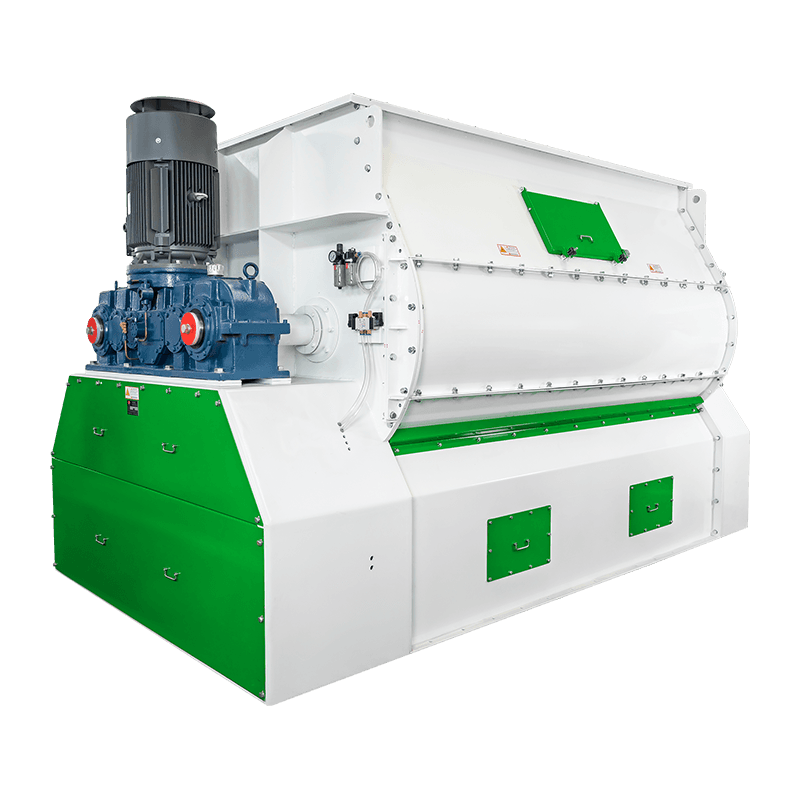
When reviewing feed mixing equipment, remember that both layouts can produce good feed, but they get there differently. A horizontal mixer turns one or two shafts inside a trough, moving material in opposing directions so convective and shear mixing happen together. A vertical mixer lifts product with a screw and lets it cascade back down, relying on gravity and a longer circulation path.
Indicative CV after a standard cycle at correct fill level. Real results depend on formula and machine condition.
| Factor | Horizontal | Vertical |
|---|---|---|
| Batch mixing time | 2 to 4 minutes | 8 to 15 minutes |
| Typical CV | 4 to 6 percent | 8 to 12 percent |
| Footprint | Long, low headroom | Compact, tall |
| Residue at discharge | Low with full-length door | Higher at cone outlet |
| Liquid addition | Even along spray bar | Possible, less even |
| Purchase cost | Higher | Lower |
When a vertical mixer still makes sense
Small farm operations, low volume batches, and sites with limited floor space often choose vertical machines. They are economical and gentle on friable ingredients, yet they demand longer cycles and close attention to fill level. For operations that change formulas daily or handle medicated products, the faster cycle and lower carryover of a horizontal layout usually offset the higher purchase price.
When horizontal is the better fit
Commercial feed mills, integrators, and premix producers value repeatable CV and short cycles. A horizontal trough also allows liquids to be sprayed across the full length of the load, which helps when fats or molasses are part of the recipe.
Plant layout can also settle the debate. Horizontal machines are usually placed above a conveyor or hopper so that discharge is quick, which keeps the mixed batch from standing and separating. Vertical machines often need an elevator or bucket system to move finished feed, and every extra transfer is another chance for segregation. Counting these downstream steps gives a more honest picture of delivered uniformity than the mixer specification alone.
Ribbon vs Paddle Configurations
Inside a horizontal trough, the agitator style shapes how material moves, how liquids are absorbed, and how much residue stays behind. Neither option is universally superior, so the choice should follow the product range.
Ribbon agitators
A ribbon agitator carries an inner and outer helix. The outer ribbon pushes product one way while the inner ribbon pushes it back, creating strong convective circulation. This suits dry, free-flowing rations and large volumes. Performance depends on the clearance between ribbon and wall, because a widened gap leaves a thin stagnant layer that slowly turns into residue.
Paddle agitators
Paddles lift and fold the load, producing a loosely fluidized zone where particles move in three dimensions. Mixing times are short, handling is gentle, and liquids disperse quickly. Paddle shafts also tolerate heavier fat inclusion with less smearing, which is valuable for high energy diets and sticky additives.
Choosing between them
- Dry, free-flowing rations at high volume: ribbon agitators are efficient and economical.
- High fat or molasses inclusion: paddles spread liquid faster and reduce smearing.
- Frequent formula changes: paddles with a full-length discharge door shorten changeovers.
- Fragile or friable ingredients: the lower shear of paddles protects particle integrity.
Many operations discover that a single answer does not fit every product line. A plant that produces dry pellet premix on one day and fat-rich starter feed on the next may benefit from a paddle configuration with variable speed control, while a mill running a narrow range of dry rations at high volume may prefer ribbons. Whatever the choice, agree on acceptance tests before delivery so that both sides know how performance will be judged.
Strategies for Uniform Micro-Ingredient Distribution
Even a well-designed mixer cannot rescue a weak addition strategy. Micro-ingredients need deliberate help to reach every part of the batch.
Use a staged premix
Dilute the active ingredient into a carrier with a similar particle size, such as ground limestone or wheat middlings, in steps of roughly one to ten. Dilution multiplies the number of particles per kilogram, which makes it far more likely that every sample contains some. A premix built in two or three stages is usually more uniform than a single direct addition.
Match particle size and density
Particles that differ greatly in size or weight separate as soon as the mixer stops. Grinding a coarse additive, choosing a carrier with matching density, or granulating a fine powder reduces the tendency to segregate during discharge and conveying.
Control the order of addition
Add bulk ingredients first, introduce micro-ingredients while the batch is already moving, and spray liquids only after the dry mix is established. Never drop micro-ingredients on a static load or directly above the discharge door, where they can slip through unmixed.
Manage liquids and fines
Oils and molasses should be atomized through a spray bar and added after the dry blend is homogeneous. Poorly dispersed liquid forms clumps that trap micro-ingredients and later break away as hot spots. Dust from fine powders can also be reduced by adding a small amount of oil to the premix.
Humidity also plays a role. Hygroscopic ingredients absorb moisture from humid air and cling to surfaces, while very dry powders carry static charge that makes them stick to the trough. Storing premix in sealed containers, avoiding long idle times between weighing and addition, and conditioning the room where possible all protect uniformity before the material even reaches the mixer. Operators who log these conditions alongside CV results often find hidden causes of seasonal variation.
Preventing Residue Build-Up and Carryover
Residue is both a nutrition issue and a safety issue. Material left inside the trough is pushed into the next batch, which creates carryover, and moist build-up can harbor mold. Discharge design has a direct effect on how much stays behind.
Common sources of build-up
- Dead zones near end plates and shaft seals where agitators do not sweep.
- Worn or widened clearance between agitator and trough wall.
- Liquids that coat the trough surface and bind fine powders.
- Leaking discharge gaskets that let material pack into the seam.
Practical controls
- Schedule production from non-medicated to medicated formulas.
- Flush with a bulk ingredient such as ground grain when changing to a sensitive formula, then quarantine the flush.
- Inspect clearances and gaskets on a fixed maintenance calendar.
- Specify polished interior surfaces, rounded corners, and access doors for visual checks.
Verify the controls with a carryover test. Run a tracer through one batch, then sample the following batch and record how much tracer appears. The result shows whether cleaning routines are working or whether design changes are needed.
Cleaning schedules deserve the same discipline as production schedules. A short, documented routine performed at every changeover is far more reliable than a thorough clean done only when a problem appears. Trained operators who know where residue collects, and who are given the time and access to remove it, protect both feed safety and the credibility of every later CV test.
Optimizing Cycle Time Without Sacrificing CV
Faster is not always better. Total cycle time includes loading, dry mixing, liquid addition, wet mixing, and discharge, and the mixing step itself is often the smallest part. The real gains usually come from the time around it.
Indicative curves. The horizontal line rises slightly after the plateau as segregation begins.
Find the plateau
CV falls quickly in the first minutes and then flattens. Extra minutes beyond the plateau cost energy, wear, and throughput, and with large density differences they can even cause demixing. Determine the optimum by sampling at one-minute increments on the most demanding formula, then set the timer slightly after the plateau begins.
Trim the non-mixing time
- Pre-stage ingredients in weigh hoppers so the mixer is never waiting.
- Overlap discharge of one batch with loading of the next.
- Use dedicated micro-ingredient dosing to avoid manual delays.
- Automate the sequence timers so every batch follows the same recipe.
Respect the fill level
Overfilling restricts movement, so ingredients cannot circulate freely. Underfilling leaves agitators partly uncovered, which reduces mixing action. Most horizontal machines perform best at roughly sixty to eighty percent of rated capacity, and the working volume should be confirmed during testing.
Finally, remember that cycle time is a system property. A mixer that completes its dry mix in three minutes but waits ten minutes for ingredients will not raise plant output, whereas a modest improvement in weighing and conveying can lift daily tonnage without touching mixing time at all. Measure the full loop from the start of one batch to the start of the next before deciding that a larger or faster machine is needed.
Selection Checklist for Your Operation
Match the design to the products you make, not to the brochure. When comparing mixer configurations, ask each supplier for test data on formulas similar to yours and review the points below.
| Question | Why it matters |
|---|---|
| Daily output and batch size | Sets mixer capacity and cycle targets |
| Medicated or sensitive formulas | Drives the CV target and residue controls |
| Fat and molasses inclusion | Influences agitator style and spray design |
| Changeover frequency | Favors full-length discharge and easy cleaning |
| Wear parts and access | Affects long-term CV stability and downtime |
| Dust and automation needs | Determines ventilation, controls, and integration |
The best machine is the one that holds its CV target on your hardest formula, on an ordinary Tuesday, months after commissioning.
Frequently Asked Questions
Q1: What CV should an animal feed mixer machine achieve?
For most complete feeds a CV of 10 percent or lower is the accepted benchmark, while premix-sensitive and medicated diets usually aim for 5 percent or lower. Confirm the figure with a tracer test at normal fill level rather than relying on a brochure.
Q2: How long should a batch be mixed?
Dry mixing in a horizontal machine commonly takes two to four minutes, plus time for liquids, while vertical machines often need eight to fifteen minutes. The right value is the point where CV stops improving, found by sampling at one-minute increments.
Q3: Is a ribbon or paddle agitator better for high fat formulas?
Paddles are generally preferred because they lift and fold the load, spread liquid fats evenly, and leave less smeared residue. Ribbons remain a strong choice for dry, free-flowing rations and large volumes.
Q4: How can residue build-up be reduced?
Specify a full-length discharge door, keep agitator clearance within the maker tolerance, replace worn gaskets, sequence batches from non-medicated to medicated, and flush with a bulk ingredient before sensitive formulas.
Q5: How often should mixing uniformity be tested?
Test at commissioning, after major repairs, and at least twice a year during routine production. Medicated feed or frequent formula changes justify more frequent checks.
Q6: Does a larger mixer always give better uniformity?
No. A larger machine only helps if it is correctly filled and matched to the batch size. Running a very large mixer far below its minimum working volume leaves agitators uncovered and can raise CV, so capacity should match the typical batch rather than the occasional peak.
 Previous