

 English
 русский
 عربى
عربىNews
Content
- 1 Why Thermal Extrusion Sets the Standard for Aqua and Pet Feed
- 2 Wet Versus Dry Extrusion: Choosing the Right Configuration
- 3 Starch Gelatinization: The Key to Digestibility and Binding
- 4 Pasteurization and Nutrient Safety Benefits
- 5 Controlling Floating and Sinking Characteristics
- 6 Water Stability of Extruded Pellets
- 7 Raw Material Selection and Particle Size
- 8 Palatability and Nutrition Gains for Aqua and Pet Feed
- 9 From Raw Material to Finished Pellet: Process Flow
- 10 Troubleshooting Common Extrusion Problems
- 11 Frequently Asked Questions
- 11.0.1 Q1: How does a feed extruder machine make feed float?
- 11.0.2 Q2: What gelatinization level should aquafeed reach?
- 11.0.3 Q3: How long should shrimp feed stay intact in water?
- 11.0.4 Q4: Can one line produce both pet food and aquafeed?
- 11.0.5 Q5: How often should screws and dies be inspected?
- 11.0.6 Q6: What moisture should extruded pellets be dried to?
Why Thermal Extrusion Sets the Standard for Aqua and Pet Feed
Fish, shrimp, dogs and cats share one nutritional reality: they only benefit from what they can digest. Raw starch, intact protein and uneven moisture all reduce nutrient uptake, and conventional pelleting leaves much of that potential unused. Thermal extrusion changes the equation by combining heat, pressure and mechanical shear for a few seconds, turning loose mash into a cooked, expanded and uniform product. A modern feed extruder machine performs this transformation inside a closed barrel, which is why it has become the preferred platform for premium aquafeed and pet food.
This guide explains how extrusion works in practical terms. It compares wet and dry configurations, shows how starch gelatinization drives digestibility and binding, and describes how operators tune density so pellets float, sink slowly or sink fast. It then covers pasteurization, water stability and palatability, and closes with a troubleshooting table and a short FAQ.
Market demand reinforces this shift. Aquaculture continues to expand, feed makes up well over half of farm operating expense, and pet owners increasingly expect digestible, safe and tasty products. Both sectors reward processors who can raise quality without raising cost per ton.
Up to 95 percentstarch cooked in a well tuned wet system
10 to 60 secondstypical residence time in the barrel
2 hours or morewater stability target for shrimp feed
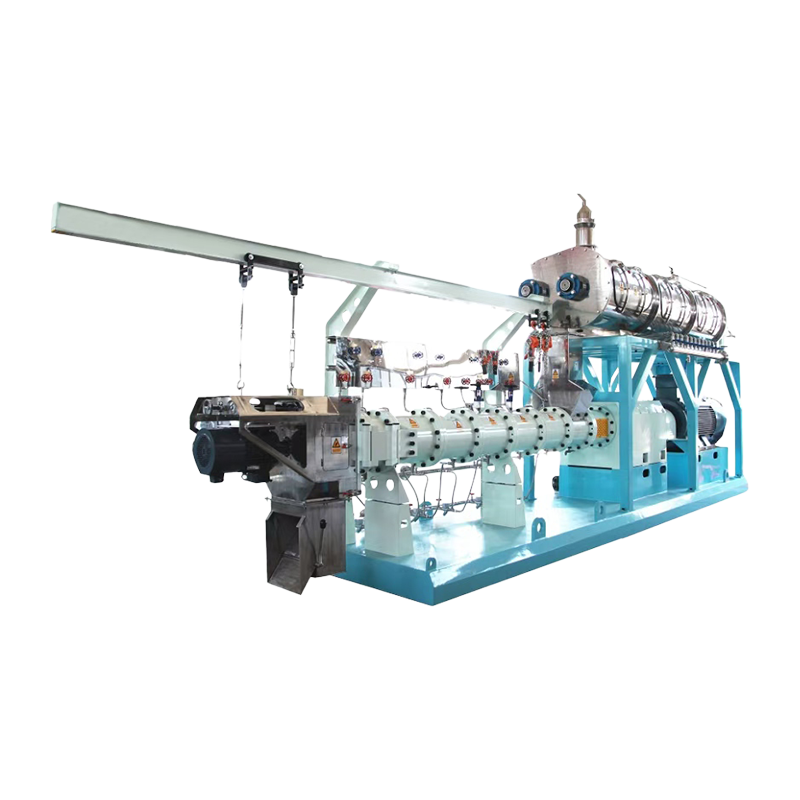
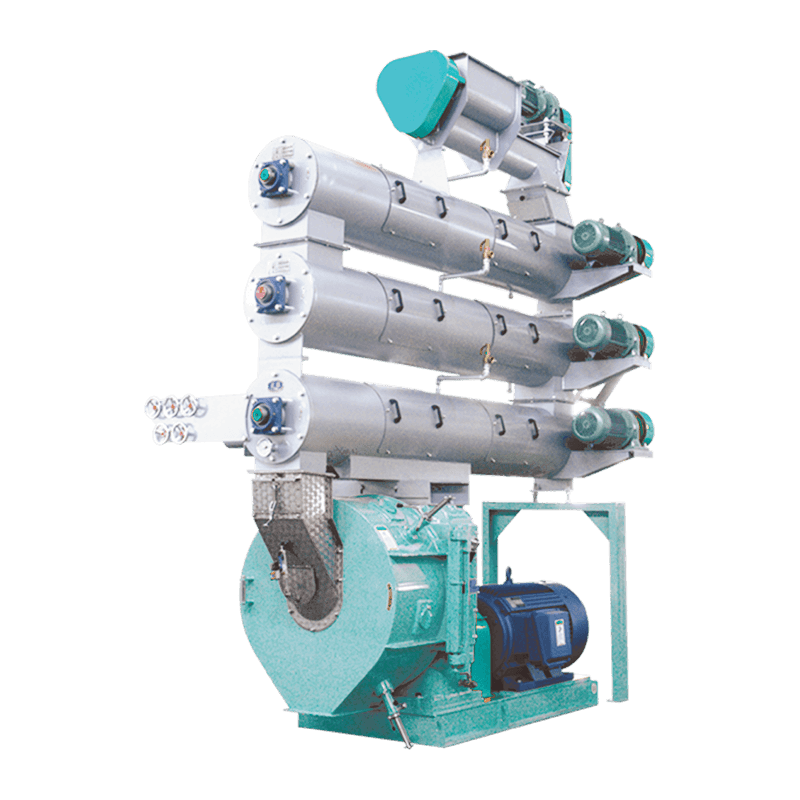
A twin screw extrusion system used for aquafeed and pet food.
Wet Versus Dry Extrusion: Choosing the Right Configuration
Both configurations share the same barrel and screw concept, but they differ in how much water and steam reach the mix before it enters the barrel. In dry extrusion, raw material is fed directly and most heat comes from friction between screw, barrel and product. In wet extrusion, a preconditioner adds steam and water first, so starch and protein are already hydrated and warm when they reach the screw.
Dry Extrusion
Dry systems are mechanically simple, cheaper to buy and easy to clean. They suit pet treats, simple kibble and floating pellets with moderate starch levels. Their limit is the energy balance: nearly all heat must come from motor load, which raises wear on screw elements and lowers fat tolerance to roughly 6 to 8 percent in the mix.
Wet Extrusion
Wet systems reach a higher cooking degree at lower mechanical energy. Material typically spends two to four minutes in the preconditioner at 90 to 100 °C, so the barrel only needs to finish the job. Output is steadier, higher fat levels are tolerated, and density can be controlled more tightly. This is the standard route for shrimp feed, high fat fish diets and premium pet food.
| Parameter | Dry Extrusion | Wet Extrusion |
|---|---|---|
| Preconditioning | None | Steam and water, 2 to 4 minutes |
| Starch gelatinization | 55 to 70 percent | 85 to 95 percent |
| Fat in the mix | Up to 8 percent | Up to 12 percent |
| Screw wear | Higher | Lower |
| Best for | Treats, simple kibble | Shrimp, premium diets |
Relative performance on a scale of 1 to 10 (indicative).
The radar view shows the trade-off. Wet extrusion wins on cooking quality, fat capacity and density control, while dry extrusion wins on simplicity. Plants producing several diets often run a hybrid approach, using the preconditioner for demanding formulas and bypassing it for simple products.
Energy use deserves attention too. Specific mechanical energy in dry systems is noticeably higher for the same product, so a preconditioner can lower electricity cost per ton and extend screw life.
Starch Gelatinization: The Key to Digestibility and Binding
Starch granules in raw cereals are tightly packed and resist enzymes. When moisture, heat and shear act together, the granules swell, lose their crystalline order and become soft and sticky. This change, called gelatinization, makes starch digestible and creates the binding matrix that holds the pellet together. Fish with limited amylase activity benefit especially from a high gelatinization degree.
Indicative gelatinization degree by processing method.
The chart shows why extrusion is hard to replace. Steam pelleting has short contact time and low moisture, so only about a third of the starch is cooked. Expanders reach about 60 percent, while preconditioned extrusion routinely exceeds 90 percent.
Variables That Move the Result
- Moisture: total moisture of 20 to 30 percent cooks starch efficiently, while below 15 percent many granules survive intact.
- Temperature: barrel discharge temperatures between 120 and 150 °C are typical for most formulas.
- Shear and screw profile: kneading blocks and reverse elements raise mechanical energy and barrel fill.
- Particle size: finer grinding hydrates faster and gives more even cooking, with most particles under 300 microns for shrimp.
Gelatinization rises with temperature, then levels off (indicative).
Notice that the curve flattens above 140 °C. Pushing temperature further adds little cooking but increases the risk of vitamin loss and protein damage, so operators usually stop where the gain per degree falls.
Gelatinization also interacts with protein. Moderate heat unfolds protein chains and improves digestibility, but excessive heat can bind amino acids such as lysine into forms the animal cannot use. The best settings therefore cook starch fully while protecting protein quality.
Pasteurization and Nutrient Safety Benefits
Heat treatment is a quality tool as much as a cooking step. Typical extrusion conditions, which combine temperatures above 100 °C with pressure and shear, cut Salmonella, Enterobacteriaceae and many mold spores to levels raw mash cannot match. This matters for pet food, where pathogen control is a regulatory and reputation issue, and for aquafeed, where contaminated feed can spread disease through a farm.
Extrusion also deactivates anti-nutritional factors in plant ingredients. Trypsin inhibitors in soybean and heat-labile lectins in legumes fall sharply after proper cooking, which lets formulators replace part of the fishmeal or animal protein with plant protein without hurting growth.
Short exposure at high temperature preserves more lysine and vitamins than long, gentle cooking, so residence time matters as much as temperature.
Post-extrusion hygiene still counts. Cooling, coating and packaging areas should be separated from raw material zones, because recontamination after the barrel is a common cause of positive tests in finished product. Regular sampling and clean-in-place routines protect the benefit that the barrel created.
Controlling Floating and Sinking Characteristics
Buoyancy is designed, not accidental. A pellet floats when it holds enough closed air cells to push bulk density below that of water, and it sinks when its structure is dense and compact. Operators control the balance through formulation, moisture and the amount of expansion at the die.
Indicative bulk density of finished products.
Floating feeds suit surface feeding fish and let farmers watch appetite. Sinking feeds suit shrimp and bottom feeders, while slow sinking feeds give mid-water species time to eat before pellets reach the bottom.
Levers for Floating Feed
- Starch level: 20 percent or more supports expansion and strong air cell walls.
- Fat in the mix: keep it under about 8 percent and add the rest by vacuum coating.
- Temperature and die pressure: more superheated water flashes into steam as product leaves the die.
- Die opening: smaller orifices raise pressure and expansion.
Levers for Sinking Feed
- Lower barrel temperature and moisture: limits expansion and keeps pellets compact.
- Heavy ingredients: fishmeal, minerals and dense binders raise bulk density.
- Larger die orifices: reduce pressure and expansion at the exit.
The table gives typical starting points. Adjust them gradually, changing one variable at a time.
| Parameter | Floating Fish Feed | Sinking Shrimp Feed | Pet Kibble |
|---|---|---|---|
| Conditioner moisture (percent) | 25 to 30 | 25 to 30 | 22 to 28 |
| Barrel temperature (°C) | 120 to 140 | 100 to 120 | 120 to 150 |
| Fat in the mix (percent) | 5 to 8 | 3 to 6 | 8 to 12 |
| Final moisture (percent) | 8 to 10 | 8 to 10 | 7 to 10 |
| Bulk density (g/L) | 350 to 420 | 580 to 650 | 300 to 420 |
Slow sinking pellets are the hardest to produce because density must sit close to that of water. Small changes in moisture or fat can move a batch from slow sinking to floating, so tight control and frequent density checks are essential. Final moisture also matters: a pellet dried to 8 to 10 percent keeps its buoyancy longer, while an under-dried pellet absorbs water and can sink within minutes.
Water Stability of Extruded Pellets
Water stability is the time a pellet holds its shape in water before softening or dissolving. Shrimp eat slowly, so a diet may need to stay intact for two hours or more, while many fish feeds need at least 30 to 60 minutes. Poor stability leaches protein and vitamins into the pond, wastes feed and damages water quality.
Stability comes from a well formed gelatinized starch network that locks protein, fiber and fat together. Four practical controls make the biggest difference:
- Grind fine and uniformly. Coarse particles leave weak points where water enters.
- Cook completely. Aim for gelatinization above 85 percent and confirm it with a laboratory check.
- Use functional binders. Small additions of wheat gluten or guar gum strengthen formulas rich in fishmeal.
- Dry and cool gently. Rapid case hardening traps moisture inside and creates cracks that let water in.
Track results for every batch: durability by tumbling, hardness, and dry matter retention after set immersion times. Plotting these values over weeks reveals drift early, long before customers notice a change in pond performance.
Die wear is a hidden cause. As die holes widen, pellets lose density and surface smoothness, and stability drops even when the recipe is unchanged.
Raw Material Selection and Particle Size
Extrusion cannot fix a poorly designed formula, so ingredient choice comes first. Starch sources such as wheat, corn and cassava provide expansion and binding, while protein sources such as fishmeal, soybean meal and poultry meal supply amino acids and influence texture. Fiber, ash and fat each change how the melt behaves in the barrel.
- Starch: wheat gives strong binding, corn gives good expansion, and cassava gives a smooth, sticky melt.
- Protein: very high protein, above 45 percent, reduces expansion and calls for more starch or steam.
- Fiber and ash: high levels weaken the structure and increase die wear.
- Grinding: consistent particle size prevents cold spots and uneven hydration.
Moisture entering the plant is equally important. Variation of even two percentage points in raw material moisture shifts torque and density, so batch checks at intake save hours of adjustment later. Stable dosing of steam and liquids keeps the melt consistent from the first hour of a shift to the last.
Palatability and Nutrition Gains for Aqua and Pet Feed
Palatability decides whether a balanced diet is actually eaten. Extrusion improves it in several ways. Cooked starch develops an appealing toasted aroma, the porous structure absorbs liquid attractants and fats, and surface texture can be adjusted from crisp to soft.
Vacuum coating is the main route to high palatability. After drying, pellets enter a vessel where air is pulled from the pores, and then oils, palatants or probiotics are applied so they are drawn deep into the structure. Fat levels of 25 to 30 percent become possible without a greasy surface, which supports energy dense diets for salmon, trout and active dogs.
AromaTextureCoatingDigestibility
For pet food, shape and size also affect acceptance. Small cats prefer smaller kibble with a crisp bite, while large dogs need pellets that encourage chewing. Die inserts and cutter speed allow these changes without altering the recipe.
Digestibility and Environmental Gains
Cooked starch and denatured protein are easier for enzymes to reach. Well extruded diets often improve feed conversion by 5 to 10 percent compared with pelleted equivalents, meaning less feed per kilogram of weight gain.
Better digestibility also means less nitrogen and phosphorus in fish waste, and in pets it means smaller, firmer stools, a benefit owners notice quickly.
From Raw Material to Finished Pellet: Process Flow
A reliable aquafeed extrusion line is a chain of controlled steps, and a weakness in any one of them reaches the final pellet. The diagram shows the usual order of operations.
Typical sequence for aquafeed and pet food production.
Cooling deserves equal attention. Pellets leaving the dryer should be cooled to within a few degrees of ambient before coating or bagging, otherwise condensation inside bags promotes mold and caking.
Selecting the Equipment
A twin screw extruder offers more flexible control of residence time and shear than a single screw, and it handles sticky, high fat or high moisture formulas more reliably. When comparing configurations, check these points:
- Modular screws with kneading and reverse elements
- Separate barrel heating and cooling zones
- Quick change die plates for different pellet sizes
- Drive power and torque margin for dense formulas
- Variable speed cutter for length control
- Easy cleaning to prevent allergen carryover in pet food
Automation also pays back quickly. Feeders, liquid dosing and temperature loops that hold set points within a narrow band remove much of the variability that operators otherwise chase by hand.
Troubleshooting Common Extrusion Problems
Most quality complaints trace back to a small group of causes. Use the table as a first checklist before changing the recipe.
| Symptom | Likely Cause | Typical Correction |
|---|---|---|
| Pellets sink instead of floating | Low expansion, high fat, low starch | Raise temperature, cut fat, check die size |
| Pellets crumble in water | Low gelatinization or coarse grind | Add steam, grind finer, add binder |
| Hollow or irregular pellets | Unstable feeding or die wear | Calibrate feeder, replace die |
| Dark color or burnt smell | Excess temperature or residence time | Lower temperature, reduce screw speed |
| Surging output | Uneven feed or moisture | Stabilize feeder and water dosing |
Document each correction with date, formula and settings. Over time this record becomes the most valuable tool in the plant, because it turns trial and error into repeatable recipes. It also shortens training for new operators and makes audits much easier.
Frequently Asked Questions
Q1: How does a feed extruder machine make feed float?
Pellets float when steam flashing at the die creates closed air cells and bulk density falls below that of water. Adequate starch, moderate fat, enough barrel temperature and a suitable die opening all support this expansion.
Q2: What gelatinization level should aquafeed reach?
Most fish and shrimp diets perform best at 85 to 95 percent gelatinization. Lower values reduce binding and digestibility, while pushing far beyond this range adds little benefit and may damage heat sensitive nutrients.
Q3: How long should shrimp feed stay intact in water?
Two hours is a common minimum, and some farms require longer. Fine grinding, full cooking, suitable binders and careful drying all extend stability, so test each batch under farm conditions.
Q4: Can one line produce both pet food and aquafeed?
Yes, if the line has interchangeable screw elements, flexible die plates and a preconditioner with proper cleaning access. Changeover between products requires careful flushing, especially for pet food allergen control.
Q5: How often should screws and dies be inspected?
Check dies weekly and screw elements every few hundred operating hours, or sooner with abrasive ingredients. Early replacement keeps density, size and output consistent.
Q6: What moisture should extruded pellets be dried to?
Most finished feeds are dried to 8 to 10 percent moisture, which supports shelf life and buoyancy. Higher moisture invites mold, while over-drying wastes energy and makes pellets brittle.
 Previous